No Results Found
The page you requested could not be found. Try refining your search, or use the navigation above to locate the post.

The page you requested could not be found. Try refining your search, or use the navigation above to locate the post.
Authors, illustrators, inventors, and developers — these diverse types of professionals are among the many who create intellectual property and rely on royalty payments to support their work. Publishers, manufacturers, distributors, and other businesses license these creations, generate revenue, and then need to calculate, pay, and track royalties accordingly.
It’s critical for all parties in royalty-related businesses to have a firm understanding of how royalties work, to agree on the variables that factor into their royalty arrangements, and to have a transparent view of how royalties are calculated.
This article presents common factors in royalty calculations, information that needs to be tracked and shared throughout the royalty process, and solutions for simplifying and streamlining the potentially complex management of royalties in business. For a closer look at how these terms get formalized, see our guide to royalty agreements.
Royalty Tracker® transforms complex royalties in business into automated precision.
You may also be interested in our Rights & Royalties Definitions – Glossary of Terms or the article “How Do Royalties Work?” Much more royalty information is available in our Resources section as well.
Royalties in business are payments made to rights holders for the licensed use of their intellectual property.
For example, consider the publishing industry. Publishing royalties are a payment structure in which an author earns a percentage of book sales, as agreed upon when the work is licensed to a publisher. This contrasts with a “work for hire” model, in which the publisher fully owns the content, and no royalties in business are paid to the author. The royalty model allows both parties to share the financial risks and potential rewards, with authors standing to gain more if the book is successful.
In addition to the book publishing business, royalties may also be employed in other businesses that involve the licensing of copyrights, patents, and trademarks, such as music, video content, software, art, characters, brands, pharmaceuticals, medical devices, other technology, and franchises, and even in the licensing of natural resources from a landowner. Understanding how royalties in business work across these different industries is essential for proper implementation.
In other words, when a property owner, or licensor, makes an agreement to allow a licensee to use the licensor’s property to generate revenue, the two parties will often agree on revenue-dependent royalty terms, rather than a flat payment of set fees.
Common examples of royalties in business include book royalties paid to authors, music royalties paid to songwriters and performers, patent royalties paid to inventors, franchise royalties paid to franchisors, and mineral or oil and gas royalties paid to landowners.
Other frequent examples include software licensing royalties, royalties on branded merchandise or character licensing, and royalties paid to universities or research institutions for licensed technology. The specific structure of each varies by industry, but all share the same underlying principle: a rights holder is paid based on the ongoing use or sale of their licensed property.
Royalties in business fall into several types, defined by how the underlying agreement is structured. There are virtually an infinite number of ways to set up a royalty agreement. The people involved in formulating the deal can be as creative in their agreements as they wish. Yet there are some common practices within certain industries.
Sometimes the royalty terms are based on the type of product being sold. Royalties for various digital products are likely to depend on format, such as streaming or downloadable audio or video, ebook, whether it’s distributed as part of a subscription, or other.
When licensing intellectual property for physical products, the frameworks for royalties in business may be even more varied, based on the types of products, costs of the products, and whether there are other licensed components integrated within that product.
Sometimes royalties can be based on the sales channel: whether it’s sold online or through a physical retail outlet.
The region in which the product is sold can also be a factor in royalty terms, and all of the above variables may be mixed and matched within a single agreement.
Royalty calculations are typically based on a percentage of either the sale price or the list price, but sometimes they are negotiated at a flat rate – e.g. $2.00 per unit sold.
Our post Different Types of Royalties & How They Work delves into the various types of royalties by industry.
Acquisition, sales processing, calculations, distribution – stop juggling manual processes when our platform handles the complete lifecycle of royalties in business seamlessly. Join hundreds of professionals who’ve automated their entire workflow. Schedule your demo today.

In intellectual property businesses, royalties are paid to the creator of the content or idea. For example in the video game space, it’s the game developer. In book publishing, authors and illustrators are the most frequent recipients of royalty payments.
In pharmaceuticals, it’s often the university that develops and licenses out the technology, and the individual inventor(s).
In the case of mineral rights or the licensing of other natural resources, the landowner will collect royalties.
But the royalty recipients, often called the “licensors” (because they grant the license to use their IP), can change. For example, if an author dies, their estate may become the royalty recipients. Or permissions to “sublicense” certain usage rights may be granted in a licensing agreement.
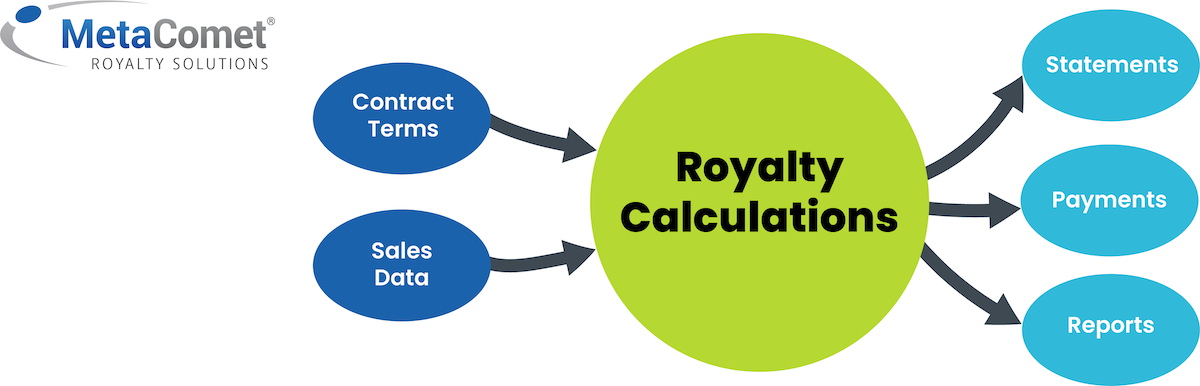
Royalties work as ongoing payments made to a rights holder whenever their licensed intellectual property generates revenue. Royalties are calculated and paid out on a regular basis according to the terms agreed upon in the contract. They may be paid monthly, quarterly, annually, or at any other interval agreed upon in the contract.
Royalties in business are often affected by factors including (but not limited to!):
A royalty recipient should have access to all of the calculations that factor into their royalty payments, so they can confirm they are being paid fairly. This creates a need for accurate and transparent royalty tracking on the licensee’s side, which should enable them to provide their royalty recipients with clear, thorough, and standardized royalty statements.
Royalties are calculated by applying an agreed-upon rate or formula to sales volume, revenue, or unit count, as defined in the royalty agreement. Royalty calculations vary in complexity, depending upon the publishing or licensing contract.
In theory, a basic royalty payment of royalties in business would be based upon a standard royalty percentage of the sales volume multiplied by the price. In actuality, the specific factors that influence a calculation, such as rate escalators, discounts, returns, reserves, and advances, can vary widely by industry and contract. For a full breakdown of how these factors work together, see our guide to how royalties are calculated.
Royalty rates vary widely across industries and agreements. Here are a couple of examples of how they may be established.
In book publishing, royalty rates fluctuate significantly depending on the publishing business model.
In “hybrid” book publishing, authors contribute to the cost of production, so royalty rates are on the higher side—ranging from 50% to 90% of net sales.
“Traditional” publishing, in which the publisher bears more risk, tends to offer lower rates, such as 25% to 50% for ebooks and around 10% for paperbacks. Hardcover royalties in traditional deals are usually a percentage of the list price. Rates may also be adjusted for highly discounted sales.
When a publisher acquires all rights to a book, they may license subsidiary rights, like film or international editions, with royalties on these deals commonly set at 50%.
In technology transfer or pharmaceuticals, the royalty rate is determined based on the value of similar or related technology, based on market research. The costs of development and the anticipated income to be generated by the technology may also be considered. Getting royalties in business right requires careful consideration of market conditions and industry standards.
In any industry, the royalty rate should not be selected without a great deal of research into the specific industry and comparable products.
Book royalties and royalties for other copyrighted materials last for the entire duration of the copyright, which in the U.S. is the creator’s lifetime plus 70 years. This means that, depending on the terms of the original agreement, an author or inventor’s heirs could continue to receive royalty payments for up to 70 years after the person’s death, as long as their product continues to generate revenue. Patent royalties may be inherited similarly.
So royalties are not paid forever: they run for a defined term set by copyright or patent law, or by the agreement itself, and stop once that term expires. Understanding this principle is an essential part of managing royalties in business over the long term.
Royalties in business are tracked through a defined royalty tracking process with four major phases:
To learn how royalty in accounting impacts your financial statements, read our guide to Royalty Calculation and the Royalty Management Lifecycle™.
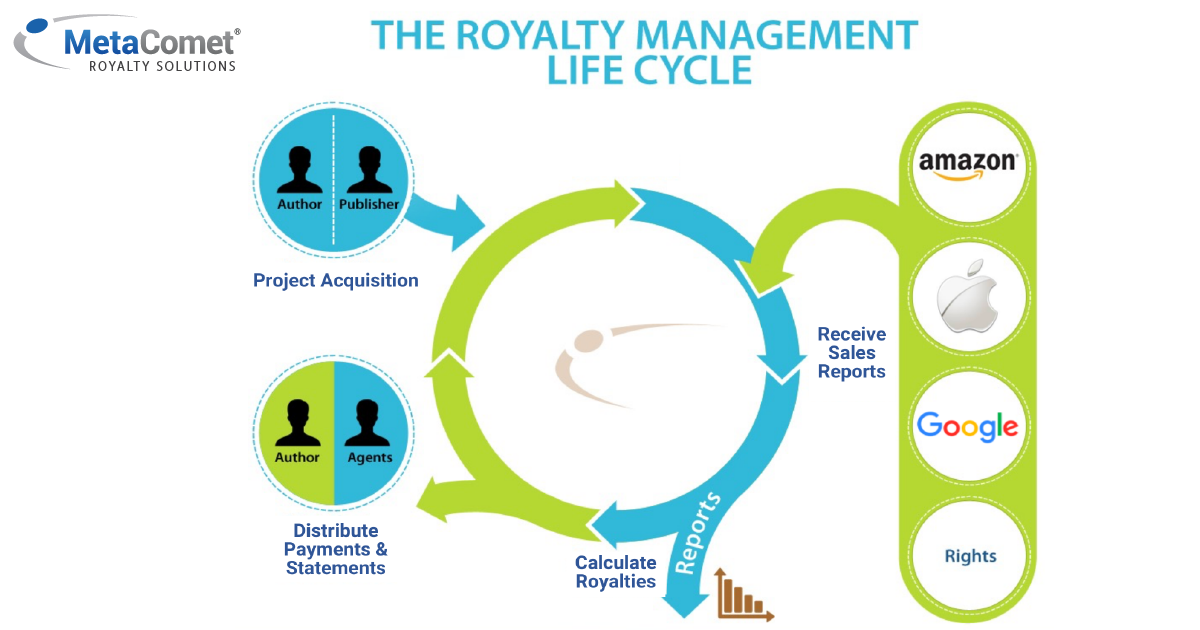
Tracking royalties in business can be made easier using specialized tools designed to manage complex royalty factors. Smaller businesses may be able to manage their royalties through spreadsheets, but once they reach a higher sales volume, most turn to an automated royalty tracking system, like the MetaComet suite of royalty management software. This includes:
If you’re curious whether royalty automation is the right solution for your business, contact us today to schedule a discovery call. Let us show you how managing royalties in business can be simplified with the right tools. We’ll happily help you figure out how to get your royalties under control.

David Marlin is the President and Co-Founder of MetaComet® Systems, a prominent provider of royalty automation tools. Since founding the company in 2000, David has spearheaded the development of a suite of best-in-class systems that effectively facilitate royalty processes for nearly 200 publishers. David has also served as the chair for The Book Industry Study Group’s Rights Committee and Digital Sales Committee.
Before establishing MetaComet Systems, David served as a technology consultant for renowned publishers, collaborating with notable companies such as Random House, Penguin, HarperCollins, Holtzbrinck, Macmillan, Scholastic, Time Warner, and many others. David holds both an MBA and a BA from Columbia University in New York.
"*" indicates required fields